
Start here · The Captain’s Course
New to krill oil? Read these in order.
- What Is Astaxanthin?
- Is Krill Oil Extracted With Hexane? — you’re here
- Phospholipid vs. Triglyceride Omega-3s
- Does Krill Oil Expire?
- Krill Oil vs. Fish Oil for Joint Pain
- Omega-3s on Ozempic, Wegovy & Mounjaro
If you’ve fallen down a late-night supplement rabbit hole and ended up on the question of how krill oil is made — congratulations, you’re asking the question almost no krill oil website wants to answer directly. The labels say things like “pure,” “premium,” “Antarctic-sourced,” and a great many of them say nothing at all about how the oil got out of the krill and into the capsule. The implication is that you don’t need to know.
You do, a little. Because the way krill oil is extracted determines what residues might tag along, how much of the good stuff (phospholipids, astaxanthin, omega-3s) survives the process, and how rancid the oil is by the time you swallow it. The short, honest answer is: most premium krill oil sold in 2026 is not extracted with hexane. The longer answer involves a small zoo of extraction methods, a 2024 European safety re-evaluation, and a label term — “solvent-free” — that means something more specific than it sounds.
Here’s the whole picture, from the boat down.
How krill oil is actually extracted (and why it matters)
Krill are tiny. About the size of a paperclip, and roughly 80% water by weight. To turn a trawler-load of fresh Antarctic krill into a teaspoon of dark-red oil, you have to separate the lipids (the oil) from everything else — protein, water, chitin shells, minerals. That separation is the extraction step, and the industry uses several different approaches.
The traditional method, going back decades, is a two-step solvent extraction with acetone followed by ethanol. Acetone pulls out the neutral lipids (the triglycerides), and ethanol pulls out the polar lipids (the phospholipids — the part of krill oil that gives it its bioavailability edge). Both solvents are then evaporated off, and what’s left is krill oil. It works, but it’s laborious, and acetone in particular is unpopular with cleaner-label brands.
Most modern premium krill oil is extracted using ethanol alone, sometimes combined with low-temperature fractionation to separate the phospholipid-enriched fraction from the neutral oil. Aker BioMarine’s Flexitech process — which produces Superba 2 and Superba Boost, two of the most-sold krill oil ingredients on the planet — uses only ethanol and relies on low temperature and efficient fractionation methods, with no high-temperature molecular distillation and no other solvents. Rimfrost, the other major krill oil producer, holds a family of patents on a solvent-free process that cooks fresh krill at around 90°C, then separates the oil mechanically with a decanter and screw press — no chemical solvents at any stage.
A 2019 head-to-head comparison published in Food Science & Nutrition tested extraction efficiency across the main methods and found this order, from least to most efficient at pulling lipids from krill meal: n-hexane (69.5%) < supercritical CO₂ (71.2%) < subcritical n-butane (82.6%) < ethanol (93.6%) < subcritical dimethyl ether (93.8%). Hexane, in other words, is actually the worst solvent for getting oil out of krill. It’s near the bottom of every modern industrial extraction process for this particular raw material. There’s a reason no major krill oil brand markets itself on hexane extraction: nobody uses it as a primary solvent for krill, because it doesn’t work as well as ethanol.
That doesn’t mean hexane is never anywhere near the supply chain. It’s still common in vegetable oil extraction, in some fish oil refining processes, and as a processing aid in concentrated omega-3 products. But for krill oil specifically, hexane is mostly a research-paper benchmark, not a production tool.
The 2024 EFSA re-evaluation: what changed, and what didn’t
The reason hexane is on anyone’s radar right now is a quietly important regulatory moment. In 2024, the European Food Safety Authority published a technical report on the need to re-evaluate the safety of technical hexane as an extraction solvent in food. The headline finding was not “hexane is unsafe.” It was “we don’t actually have enough data to confidently say it’s safe at modern exposure levels, especially for infants and young children.”
A few specifics worth knowing. Technical hexane is not a single chemical — it’s a mixture of n-hexane and related compounds whose impurities are poorly specified in current regulatory frameworks. Human absorption of n-hexane is well documented. And the exposure assessment models in use since the 1990s may have underestimated how much residual hexane actually shows up in food and food ingredients today. EFSA’s official position is that current safety assessments remain valid and products using hexane continue to be considered safe under existing regulations — but the agency is collecting fresh data and the re-evaluation is ongoing.
The toxicology that drove the original concern is real, but it’s almost entirely occupational. n-Hexane is a recognized peripheral neurotoxin first identified in 1964, and the cases that ended up in the medical literature came from shoe factories, printing plants, and furniture workshops with poor ventilation, where workers inhaled large quantities of vaporized solvent every day for years. The neurotoxic effects are caused by a metabolite (2,5-hexanedione) that accumulates with chronic high-dose exposure. The doses involved in residual food contamination are several orders of magnitude lower. There is no clinical evidence that consumer-level exposure to hexane residues in food causes neuropathy. But it’s also true that nobody has run the long-term study at modern exposure levels in infants and small children, and that’s the gap EFSA is now asking about.
The practical takeaway: if you’re buying a premium krill oil from a major brand in 2026, hexane probably isn’t in the supply chain in any meaningful way. If you’re buying the cheapest no-name omega-3 you can find on a marketplace site, you might not know.
What “solvent-free” actually means on a label
“Solvent-free” is one of those phrases that means a specific thing in a regulatory document and a fuzzier thing on a supplement bottle. There are two ways the term gets used.
The first is mechanical extraction without chemical solvents at any stage. This is the Rimfrost-style approach — cook the krill, separate the oil physically using temperature, gravity, and pressure. No ethanol, no acetone, no hexane, no CO₂. The yield is lower and the equipment cost is higher, but the oil that comes out has no solvent residues to speak of because no solvent was ever introduced. This is the most defensible version of “solvent-free.”
The second, more common, version is solvent extraction followed by complete solvent removal. Ethanol-extracted krill oil, once the ethanol has been distilled off and the residual measured below regulatory limits, is sometimes marketed as “ethanol-free” or “free from harmful solvents.” That’s technically accurate — the finished oil contains only trace solvent — but it’s not the same thing as having never used a solvent. The distinction matters more to clean-label purists than to anyone tracking actual health outcomes, but if the label phrase matters to you, it’s worth asking the brand to clarify which definition they’re using.
A third version is the catch-all marketing phrase “no chemical processing,” which can mean anything from “we use only ethanol, which is a chemical” to “we cook and press.” When you see that phrase, the European food consumer information body EUFIC notes that you usually have to look at the manufacturer’s technical documentation to know what’s actually going on, because the label doesn’t tell you.
What residue levels actually look like
For perspective on how small “residue” gets in finished oil: EU regulations cap residual n-hexane in fats and oils at 1 mg/kg (1 ppm). For specific ingredients like degreased flours and protein products it’s higher, but for the oils most likely to end up in a supplement, the limit is parts-per-million. Modern analytical methods can detect hexane down to the parts-per-billion range, and well-run ethanol-extraction facilities typically report residual ethanol in finished krill oil well below the regulatory ceiling.
Ethanol itself, for what it’s worth, is the same molecule as the alcohol in beer and wine. Residual ethanol in a finished krill oil capsule is measured in micrograms per dose — orders of magnitude below anything you’d get from a sip of a beverage. The honest concern with ethanol extraction isn’t toxicity; it’s whether the temperatures used to remove it damaged the omega-3s or the astaxanthin on the way through. That’s a process-quality question, not a solvent-residue question.
The questions actually worth asking
If you care enough about how your krill oil was made to read this far, here are the questions that separate a transparent supplier from a cagey one:
What solvent, if any, is used in primary extraction? “Ethanol only” and “solvent-free mechanical” are both legitimate honest answers. “Proprietary” is a flag. The answer should be one sentence and shouldn’t require legal review.
What’s the residual solvent specification, and is it tested per batch? A real supplier can tell you the spec (e.g., “ethanol < 50 ppm per batch, certificate of analysis available on request”). A reseller usually can’t.
What temperatures does the oil see during processing? Krill phospholipids and astaxanthin are heat-sensitive. Low-temperature processing (under 60°C for most steps) preserves more of what makes krill oil worth taking in the first place.
What’s the TOTOX value (total oxidation) of the finished oil? Industry voluntary spec is under 26; the best krill oils come in well below 10. This tells you how rancid the oil is when it gets to you — which, for any omega-3 supplement, matters more than almost anything else.
A supplier that can answer those four questions in plain English is operating in good faith. A supplier that can’t is hoping you won’t ask.
A note on Captains Krill Oil
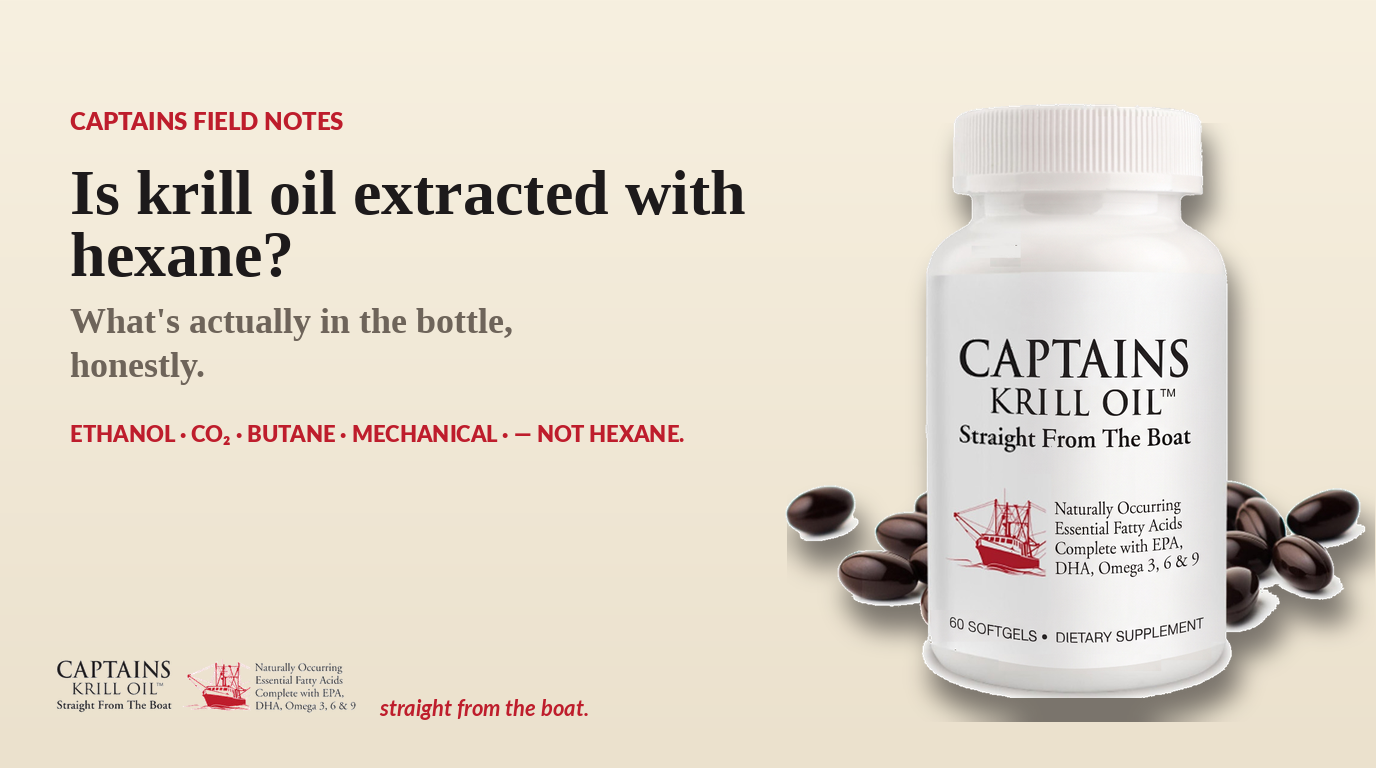
This whole article was triggered by a question we get every few weeks: “Is your krill oil extracted with hexane?” The answer is no. The honest, longer answer is that the entire premium krill oil industry has moved away from hexane over the last fifteen years, mostly because it’s a worse solvent for this particular raw material — not because of any high-minded clean-label crusade. Captains Krill Oil is mechanically extracted — cooked and pressed, no chemicals at any stage. It’s a natural catch, not a factory product tuned to a spec, so the numbers vary a little from lot to lot — but we test lots at random, and they come back strong. Want to see the documentation? Ask and we’ll send it. If you’d rather buy from somebody who uses a different process, that’s a choice too. The point is that you should be able to find out, in plain English, before you swallow it.
That, more than any single extraction method, is what separates a supplement worth taking from one that isn’t.
Sources: EFSA technical report on hexane re-evaluation (2024) · Sun et al., Food Science & Nutrition (2019), ethanol-hexane vs. subcritical extraction comparison · Aker BioMarine Flexitech patent coverage · Rimfrost solvent-free extraction patent · EFSA P12-10 re-evaluation rationale (2025) · PubMed: n-hexane toxic neuropathy case series · Medscape: n-hexane-related peripheral neuropathy review · EUFIC: is hexane in food a cause for concern? · SGS Fresenius: hexane in food, risk assessment, analysis
Read next
Don’t take our word for it.
We’re the krill oil from a boat, not a factory — but you should hear it from customers, not from us. Real, unedited reviews from Google and Amazon, each linked to its original.
Read 50+ real Captains Krill Oil reviews Read next: Why Captains Won’t Print an Exact EPA/DHA Number — https://captainskrilloil.com/why-captains-wont-print-exact-epa-dha/
Prefer the 2-pack on Amazon (Prime): https://www.amazon.com/dp/B00VAYXILI
Or start here: https://captainskrilloil.com/no-fishy-burp/