
Start here · The Captain’s Course
New to krill oil? Read these in order.
- What Is Astaxanthin?
- Is Krill Oil Extracted With Hexane?
- Phospholipid vs. Triglyceride Omega-3s — you’re here
- Does Krill Oil Expire?
- Krill Oil vs. Fish Oil for Joint Pain
- Omega-3s on Ozempic, Wegovy & Mounjaro
Phospholipid omega-3s (krill oil) and triglyceride omega-3s (fish oil) carry the same EPA and DHA. The phospholipid form gets a little more of it into your blood at a matched dose over months, the triglyceride form is cheaper per milligram, and both beat the ethyl-ester form most bargain fish oil is made of. That’s the whole answer; the rest of this page is the evidence and the exceptions.
We sell Captains Krill Oil™, which is the phospholipid form, so read us with that in mind. The honest version up front: if you’re already taking a fish oil you tolerate and take every day, the form probably doesn’t matter enough to switch. The intake is the point. The form is a detail — until it’s the reason you quit.
Two quick disambiguations, because search engines mix these up. If you’re here about blood triglycerides — whether krill oil lowers the number on your lipid panel — that’s a different question with its own page. And if you want to know how much phospholipid is in a given krill oil and whether 56% beats 40%, that’s here. This page is about the chemical form the omega-3 rides in.
Three forms, one fatty acid
EPA and DHA are the same molecules regardless of packaging. What differs between supplements is the vehicle those molecules ride in from your gut into your bloodstream. There are three you’ll actually meet on a shelf.
Ethyl esters (EE). The cheapest concentrated form. During processing, fish oil is reacted with ethanol so the EPA and DHA can be distilled up to higher strengths; the result is an omega-3 bonded to an ethanol molecule, a structure that doesn’t exist in any food. Your pancreatic lipase handles it slowly and needs a fatty meal to do it at all. Most bargain-shelf fish oil, and the prescription products Lovaza and Vascepa, are ethyl esters. Labels rarely say so.
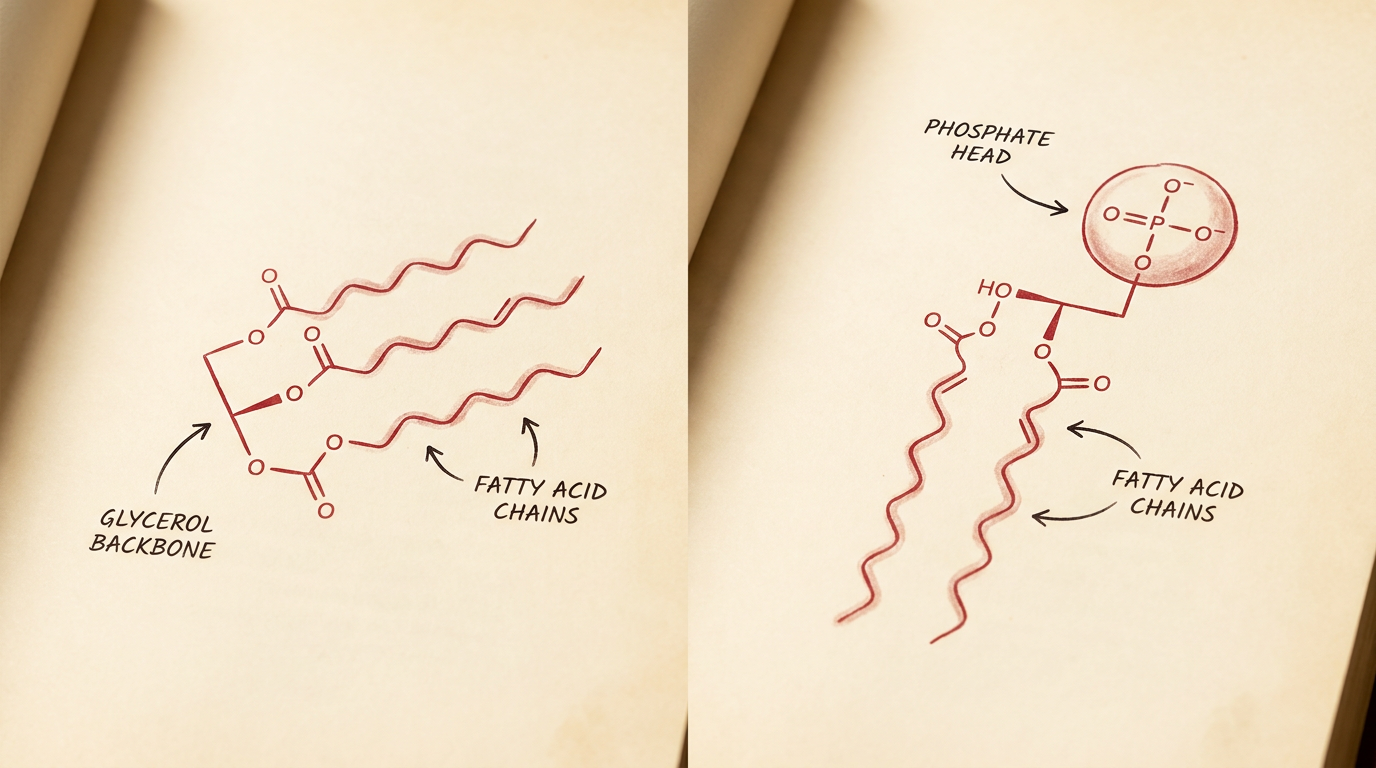
Triglycerides (TG). The form in fish. Three fatty-acid chains on a glycerol backbone; your digestion evolved on it. Natural fish oil is TG at fish-strength (about 30% EPA+DHA). “Re-esterified triglycerides” (rTG) are ethyl esters that have been converted back to triglyceride after concentration — the best of both, and the form in most mid-to-premium fish oil.
Phospholipids (PL). The form in krill. Two fatty-acid chains plus a phosphate head that’s water-friendly — the same architecture as your cell membranes. Because one end mixes with water, phospholipids emulsify in the stomach instead of floating on top of it, and they’re absorbed without needing a fatty meal. In krill oil, most of the EPA and DHA is bound to phospholipids, mainly phosphatidylcholine; the rest is ordinary triglyceride.
What the absorption studies actually show
Here’s the evidence in the order it was produced, including the trials that go against us.
Ethyl ester vs. triglyceride is settled. In 2010, a Danish group gave 72 volunteers about 3.3 g a day of EPA+DHA in five different forms for two weeks. Taking natural fish oil as 100%, re-esterified triglycerides came in at 124% bioavailability and ethyl esters at 73%. And the ethyl-ester gap widens on an empty stomach: the ECLIPSE trial found that with a low-fat meal, ethyl-ester omega-3 absorbed roughly four times worse than a free-fatty-acid form. If your fish oil is EE and you take it with coffee, you’re paying for omega-3 you’re not absorbing.
Phospholipid vs. triglyceride is closer, and the early trials were sloppy. The first head-to-heads gave people the same oil weight, not the same omega-3 dose, and krill oil “won” partly because nobody matched the milligrams. When DSM — a fish oil company — ran a matched trial in 2015 (66 adults, 1.3 g a day of EPA+DHA as fish-oil TG, fish-oil EE, or krill oil for four weeks), plasma EPA+DHA was the same across all three. Matched for dose, the form bought nothing in four weeks. That’s the strongest result against the phospholipid case, and we’re stating it in full.
The single-dose kinetics favor krill — for an unexpected reason. A 2015 Finnish crossover gave 15 people about 1.7 g EPA+DHA as krill oil, krill meal or fish oil and tracked plasma for 72 hours. Krill oil’s incorporation into plasma phospholipids was about 50% higher than fish oil’s. But krill meal — also phospholipid-rich — did worse than fish oil, which suggests the advantage isn’t the phospholipid alone but how the oil is packaged and digested. Honest scientists flagged that; krill marketers didn’t.
Red blood cells tell a slightly different story than plasma. In 2013, a 24-person crossover gave 600 mg a day of omega-3 as krill oil or fish oil for four weeks each. Krill oil raised the omega-3 index — the share of EPA+DHA in red-cell membranes — more than fish oil at the same dose. Small study, Enzymotec-funded, but the membrane measure is the one that arguably matters.
The newest and best trial favors phospholipid over months. In May 2026, a University of Sherbrooke team funded by the Canadian Institutes of Health Research — no industry money — published a 72-person, 12-week randomized trial in the American Journal of Clinical Nutrition. Both groups got about 1.1 g a day of omega-3, matched. The krill group’s plasma EPA and DHA rose roughly 1.5 times as much as the fish oil group’s. The authors’ own caution is worth quoting: the difference is “probably not related to higher absorption” and more likely to how the body handles phospholipid-bound fat after it’s absorbed, and higher plasma levels “do not necessarily translate into superior clinical outcomes.”
The pooled picture. A 2024 network meta-analysis put it together across doses and found the phospholipid advantage is real at doses under about 2 g a day — the range almost everyone supplements in — and fades at high doses, where you’re overwhelming the difference with volume.
Read together: four weeks and a matched dose, the forms tie. Twelve weeks and a matched dose, phospholipid pulls ahead by about half again. Neither result says your knees or your cardiologist will notice; no trial has shown a clinical outcome difference between the two forms, and a 2024 meta-analysis of 64 trials found no difference in blood lipids between krill and fish oil. Better absorbed is not the same as better for you. It’s the same molecule arriving a bit more efficiently.
Why the form decides whether you actually take it
This matters more than any bioavailability chart. Fish burps are the single most-cited reason people quit fish oil. Triglyceride oil doesn’t mix with water; it floats on your stomach contents, and any reflux tastes like the fish counter. The bigger the capsule, the worse it gets, and standard fish oil capsules aren’t small. Phospholipids emulsify — one end grabs water, the other grabs fat, the way egg yolk holds a vinaigrette together — so krill oil is much less likely to repeat on you. We’ve written the full mechanism up, including the part where a rancid fish oil burps worse than a fresh one regardless of form.
For a healthy adult that’s a comfort difference. For someone with reflux, someone on a GLP-1 drug where nausea is already the daily weather, or anyone who quietly stopped taking fish oil because it was unpleasant, it’s the difference between a supplement you take and one that lives in the cabinet. It also means krill oil works on an empty stomach in a way ethyl-ester fish oil does not.
Consistency beats potency. A 500 mg dose you take daily outperforms a 2,000 mg dose you take when you remember, which outperforms a 3,000 mg dose you bought once, tried twice, and abandoned.
How to tell which form your fish oil is
The label usually won’t say “ethyl ester.” Here’s how to read around that.
The concentration tells you. Natural fish oil tops out around 30% EPA+DHA — roughly 300 mg per 1,000 mg softgel. If a bottle claims 500–900 mg of EPA+DHA per 1,000 mg capsule and doesn’t say “triglyceride form,” “rTG,” or “re-esterified,” it is almost certainly ethyl ester, because that’s the cheap way to get there. Good brands that pay for rTG say so on the front, since it costs them more.
The price tells you. Concentrated omega-3 at a rock-bottom price per capsule is ethyl ester. Converting back to triglyceride is an extra manufacturing step nobody does for free.
The prescription is EE. Lovaza and Vascepa are ethyl esters; their labels tell you to take them with food for exactly this reason. Not a knock — they’re dosed high enough that it works — but it’s why “prescription strength” isn’t the same as “best absorbed.”
Krill oil is phospholipid by definition — unless it’s been cut. A krill oil label with no phospholipid figure at all is the one to question; here’s why.
The astaxanthin footnote
Krill oil is red because of astaxanthin, a carotenoid the krill collect from the algae they eat. It isn’t added in manufacturing. Its practical job in the capsule is to protect the omega-3 from oxidizing — fish oil makers add tocopherols to do the same work — which is part of why krill oil keeps its color as a freshness gauge. Whether the milligram or so in a serving does anything in you is a separate and more modest story.
Where the form doesn’t matter
If you eat fatty fish twice a week — salmon, sardines, mackerel, anchovies; not tilapia — you don’t need any of this. Fish delivers omega-3 as natural triglyceride, packaged with the fat and protein your gut was built for. No capsule beats that.
If you take a re-esterified triglyceride fish oil with a meal and tolerate it, you’re already near the top of the hierarchy. Switching to krill would get you a somewhat different absorption profile and smaller capsules; the matched-dose evidence says the practical difference over a month is small. Don’t fix what isn’t broken.
If cost is the constraint, a plain triglyceride fish oil taken every day with food gets the job done. It absorbs less efficiently than rTG or phospholipid, but the gap narrows with food, and the biggest variable is still whether you take it at all.
Where it does matter
The form matters when tolerability is the bottleneck — when you tried fish oil and the experience made you stop. It matters when the dose has to be small because appetite is low, stomach space is limited, or nausea is already part of the day. It matters when you want to move your omega-3 index with the fewest capsules. And it matters if the fish oil in your cabinet is ethyl ester and you take it without a meal, because in that case you’re mostly buying hope.
Captains is one option in the phospholipid space. Ours is pressed mechanically on the boat, no solvents at any stage, no concentration step afterward — a natural oil that varies a little lot to lot; we test lots at random and they come back strong. But the brand matters less than this: get EPA and DHA from somewhere, in a form you’ll actually take, at a dose that moves your number. The molecule is the point. The vehicle is just how it gets there.
If you want to know where you stand, an omega-3 index test costs about $50 and gives you a real number. Target is 8% or higher; most Americans sit at 4–5%. That number matters more than which bottle is on your shelf.
Honest answer, not a pitch. — captainskrilloil.com
Frequently asked questions
What is the difference between phospholipid and triglyceride omega-3s?
The EPA and DHA are identical; the carrier differs. Krill oil binds most of its omega-3 to phospholipids, the membrane-type fat with a water-friendly head; fish oil delivers it as triglycerides, the storage-type fat. Cheap concentrated fish oil uses a third form, ethyl esters, that exists in no food.
Which is better absorbed, phospholipid or triglyceride fish oil?
At a matched omega-3 dose, a four-week trial found no difference, and a 12-week 2026 trial found phospholipid raised plasma EPA and DHA about 1.5 times as much. Both are well ahead of ethyl esters, which absorb up to four times worse on an empty stomach. Over months, phospholipid has the edge; over weeks, it’s a tie.
Is the triglyceride form of fish oil good?
Yes. Natural and re-esterified triglyceride fish oil are the forms your digestion was built for, and rTG tested at 124% of natural fish oil’s bioavailability against 73% for ethyl esters. Taken daily with a meal, a good triglyceride fish oil is a perfectly sound omega-3 source.
How do I know if my fish oil is ethyl ester or triglyceride?
Labels rarely say “ethyl ester.” If a 1,000 mg capsule claims well over 300 mg of EPA+DHA and doesn’t say “triglyceride,” “rTG,” or “re-esterified,” it’s almost certainly ethyl ester. Brands that pay for the triglyceride form say so on the front. Prescription Lovaza and Vascepa are ethyl esters.
Does better absorption mean better health results?
Not by itself. No trial has shown a clinical outcome difference between phospholipid and triglyceride omega-3s, and a 2024 meta-analysis of 64 trials found no difference in blood lipids between krill and fish oil. The 2026 trial’s own authors said higher plasma levels don’t necessarily mean better outcomes.
Are omega-3 phospholipids the same as krill oil?
Krill oil is the main dietary source of omega-3 phospholipids, but not the only one: fish roe and some “phospholipid-enhanced” fish oils carry them too, and a few products add krill to a fish oil base. The phospholipid figure on a label is what tells you how much of the oil is in that form.
Does the form matter if I already take fish oil?
If you tolerate it and take it every day with food, probably not enough to switch. The form matters most when burps, reflux, or capsule size made you quit, when you take it without a meal, or when your fish oil is ethyl ester and you didn’t know.
Does krill oil lower blood triglycerides?
That’s a different “triglyceride.” Blood triglycerides are the number on your lipid panel, and the honest evidence there is mixed and dose-dependent — we cover it separately on our krill oil and cholesterol page. This page is about the chemical form the omega-3 comes in.
Read next
Don’t take our word for it.
We’re the krill oil from a boat, not a factory — but you should hear it from customers, not from us. Real, unedited reviews from Google and Amazon, each linked to its original.
Read 50+ real Captains Krill Oil reviews Read next: Why Captains Won’t Print an Exact EPA/DHA Number — https://captainskrilloil.com/why-captains-wont-print-exact-epa-dha/
Prefer the 2-pack on Amazon (Prime): https://www.amazon.com/dp/B00VAYXILI
Or start here: https://captainskrilloil.com/no-fishy-burp/