
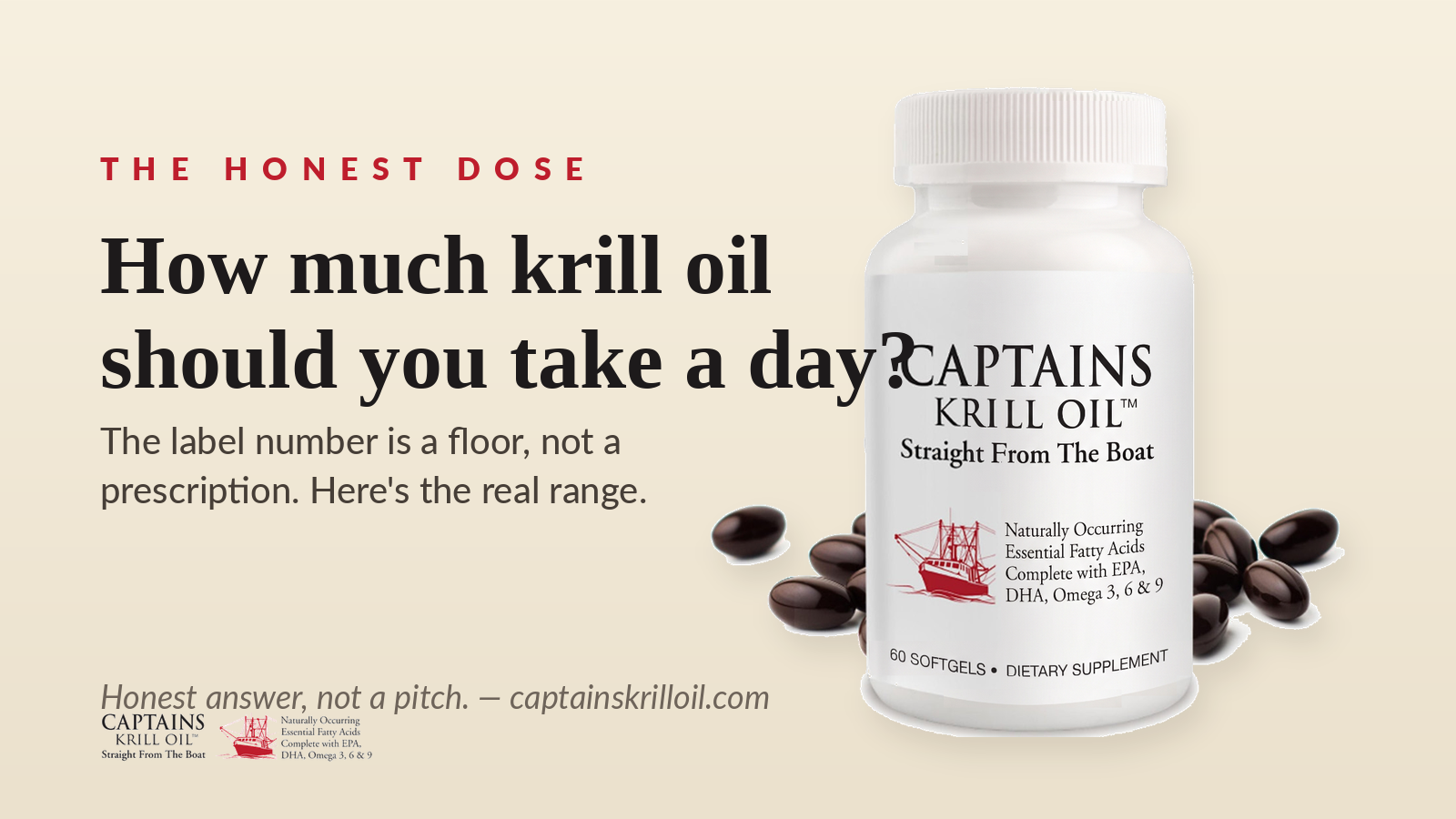
If you’ve just bought a bottle of krill oil, or you’re standing in the aisle about to, the question on your mind is the simplest one there is: how much of this do I actually take? The label says one or two capsules. That answer is fine, the way “drink water” is fine advice — technically true and almost useless for deciding what you specifically should do.
Here’s the honest version, and it’s going to be less tidy than the bottle. The right daily dose of krill oil isn’t a fixed number. It depends on what you’re trying to accomplish, how much omega-3 you’re already getting from food, and — if you want to do this properly — a cheap blood test that tells you where you actually stand. For general maintenance, a few hundred milligrams of combined EPA and DHA a day is plenty. For an elevated cardiovascular risk, the target climbs toward a gram or more. For high triglycerides or a serious anti-inflammatory effect, the research uses 2 to 4 grams of EPA and DHA a day, which is more than most krill oil bottles will get you without taking a small handful of capsules.
So the label number is a floor, not a prescription. Let me walk you through how to find your actual number, because once you understand the logic it stops being confusing.
The short version, before the details
For most healthy adults who just want to cover their bases, aim for roughly 250 to 500 milligrams of combined EPA and DHA per day. That’s the range most public-health bodies converge on, and it’s the figure the American Heart Association points to for general cardiovascular maintenance. Note that this is milligrams of EPA and DHA, the two omega-3s that actually do the work — not milligrams of krill oil, which is a different and larger number I’ll come back to.
If you have a known reason to want more — heart disease risk, high triglycerides, persistent joint inflammation — the dose goes up, sometimes a lot. And if you genuinely want to know whether your dose is working, you stop guessing and measure. That’s the part almost nobody does, and it’s the part that actually matters.
Why the number on the label isn’t really a dose
A krill oil capsule is mostly krill oil — but only a slice of that oil is the EPA and DHA you’re taking it for. A typical 500 mg krill oil capsule contains around 60 mg of EPA and 30 mg of DHA, so about 90 mg of the omega-3s that count. Take the “two capsules daily” on the label and you’re getting somewhere near 180 mg of EPA and DHA — under the bottom of the general maintenance range.
That’s not a knock on krill oil specifically; it’s how supplement labels work. The big number on the front of the bottle is the weight of the oil, and the number that determines whether the product does anything is buried in the supplement-facts panel, often in smaller print. The single most useful habit you can build as a supplement buyer is to ignore the front of the bottle and read the EPA and DHA milligrams on the back. Two products that both say “1000 mg krill oil” can deliver very different amounts of actual omega-3.
One honest caveat, since this whole article leans on those back-panel numbers: on a minimally processed, natural marine oil they’re a typical value, not a locked guarantee. A heavily processed fish oil concentrate is engineered to hit a precise, repeatable EPA and DHA spec; a natural krill oil is closer to whatever the ocean actually delivered that season, and a wild catch varies a little from lot to lot. That’s not a flaw — it’s the difference between a manufactured number and a natural one — but it does mean you should treat the label figure as a planning estimate and look for a maker that tests its lots to confirm the oil reliably comes in strong. That, not a number printed for the front of a box, is the real assurance.
So when someone asks “how much krill oil should I take,” the real question hiding inside it is “how much EPA and DHA do I want, and how many capsules of this particular product does it take to get there?” Answer that and you’ve answered the dose.
The better question: what’s your omega-3 index?
Here’s where I can save you from guessing entirely. There’s a blood test called the omega-3 index that measures the percentage of EPA and DHA in your red blood cell membranes. It’s a stable, months-long picture of your omega-3 status — not a snapshot of what you ate yesterday — and it’s the closest thing we have to a real readout of whether your dose is working.
The index was first proposed in 2004 by researchers William Harris and Clemens von Schacky, who looked across the existing studies for the level associated with the lowest risk of dying from heart disease and landed on a target of 8% or higher. For reference, the traditional Japanese diet, with its high fish intake, tends to produce index values around 9 to 10%, while a typical Western diet often lands in the 4 to 5% range. A 2025 review in Current Opinion in Clinical Nutrition and Metabolic Care confirms that the index continues to hold up as a meaningful marker of cardiovascular and broader health risk.
The reason the test is so useful for dosing is that it turns “how much should I take” into arithmetic. If your index comes back between 4% and 8%, the general guidance is to add roughly 500 to 1,000 mg of EPA and DHA a day. If it’s below 4%, you’re looking at 1 to 3 grams a day to climb into a healthy range. Retest in three or four months — that’s how long red blood cells take to turn over — and you’ll see whether your dose moved the number. Test, adjust, retest. It costs about as much as a couple of bottles of supplements, and it ends the guessing for good.
Matching the dose to the goal
If you’d rather not test, you can at least match your dose to your reason for taking it, because the research uses very different amounts for different jobs.
For general maintenance in a healthy adult, the 250 to 500 mg of EPA and DHA a day mentioned above is the consensus target. For established cardiovascular risk, the useful intake rises toward 1 gram a day and up. And for high triglycerides, the dose jumps into prescription territory: the American Heart Association’s science advisory concluded that 4 grams a day of EPA and DHA, taken with food, reliably lowers triglycerides by 20 to 30% — but that’s a clinical dose for a clinical problem, and it’s a conversation to have with a doctor, not something to improvise from a supplement aisle.
Joint inflammation sits in a similar high-dose zone. The krill oil trials that showed a benefit for knee pain generally used 2 to 4 grams of oil a day for months at a time, not the one-or-two-capsule label dose. Whatever omega-3s do for an inflamed joint, they do it slowly, over 8 to 12 weeks of consistent use, at doses well above maintenance. If you’re taking a single daily capsule and expecting your knee to feel different by Friday, the dose, not the molecule, is why you’re disappointed.
The krill oil wrinkle: better absorption, smaller payload
There’s a genuine point in krill oil’s favor worth being honest about. Krill oil carries its EPA and DHA in phospholipid form, which mixes more readily into the watery contents of your gut than the triglyceride or ethyl-ester forms in standard fish oil. Several studies — including a comparative bioavailability trial and a more recent 2024 pharmacokinetic study — found that gram for gram, you absorb omega-3s from krill oil somewhat more efficiently. One trial even showed that higher-phospholipid krill oil raised red-blood-cell EPA and DHA more than a lower-phospholipid version.
But notice what that does and doesn’t mean for your dose. “Absorbed more efficiently per milligram” is not the same as “more omega-3 in the bottle.” Because krill oil bottles tend to carry less EPA and DHA per gram than concentrated fish oil, the absorption advantage largely offsets the lower payload rather than stacking on top of it. The practical upshot: you may need fewer milligrams of omega-3 from krill than from fish oil to reach the same blood level, but you’ll often need more capsules of krill oil to get those milligrams in the first place. Don’t let the (real) absorption story trick you into under-dosing. Read the EPA and DHA numbers and do the math regardless of the form.
How much is too much
It’s hard to overdose on omega-3s, but there is a sensible ceiling. The U.S. FDA’s guidance is to keep total combined EPA and DHA intake under about 3 grams a day, with no more than 2 grams of that coming from supplements, unless a doctor is supervising a higher dose — which they routinely do for triglycerides at 4 grams. The NIH Office of Dietary Supplements notes that very high intakes can mildly thin the blood and, at the high end, may cause minor effects like a fishy aftertaste or loose stools long before anything dangerous.
The one real caution is if you take blood thinners — warfarin, apixaban, even daily aspirin. Omega-3s add a mild blood-thinning effect of their own, and while it’s small at typical doses, it’s the kind of thing your doctor should know about rather than discover. That’s a “mention it at your next appointment” item, not a reason to avoid the supplement.
So what should you actually do
If you want the simplest defensible plan: take enough krill oil to land around 500 mg of combined EPA and DHA a day, which for most products means reading the back panel and taking however many capsules get you there — often two or three, sometimes more. Take them with a meal, take them every day, and give it a few months before you judge anything, because omega-3s work on the timescale of seasons, not days.
If you want to do it properly, spend the money on an omega-3 index test instead of buying a bigger bottle on faith. Find out where you actually are, dose to close the gap, and retest in a few months. It’s the difference between hoping a supplement is working and knowing.
And if your reason for taking krill oil is a real medical one — heart disease, high triglycerides, an inflamed joint that won’t settle — the honest answer is that your dose belongs in a conversation with a clinician, because those targets run higher than any label will tell you and they’re worth getting right.
A note on Captains
We make a krill oil, so you’d expect me to tell you to take more of it. Instead I just told you to read the back of the bottle, do the arithmetic, and consider spending your next forty dollars on a blood test rather than on us. That’s deliberate. And here’s the part a lot of brands fudge: a krill oil isn’t a pharmaceutical blended in a factory to hit a chosen EPA and DHA number. One scientist will tell you this figure is the right one, the next will name a different one, and the research keeps moving the target — so a “perfect” number printed on a label is mostly theater. Ours is a natural catch, mechanically extracted with no chemical solvents at any stage, and like anything wild it varies a little from lot to lot — so we don’t manufacture our oil toward a figure and pretend the ocean reads our label. What we do instead is test lots at random, and they come back strong every time we look. We’d rather trust what nature put in the krill than chase a number nobody fully agrees on. Dose to your goal and your blood work, not to a figure someone engineered for the front of a box. Honest answer, not a pitch. — captainskrilloil.com
Read next: Why Captains Won’t Print an Exact EPA/DHA Number — https://captainskrilloil.com/why-captains-wont-print-exact-epa-dha/
Read next
Prefer the 2-pack on Amazon (Prime): https://www.amazon.com/dp/B00VAYXILI
Or start here: https://captainskrilloil.com/no-fishy-burp/
6 thoughts on “How Much Krill Oil Should You Take a Day? The Honest Range”
Comments are closed.